

Discretionary Trust Deed
A Discretionary Trust Deed is used to establish a discretionary trust in any state or territory in Australia.
4.6 (209 reviews)
Last updated October 23, 2025
Under 10 minutes
Suitable for Australia
Trusted by








Why we are trusted by 500,000 businesses
Up-to-date compliance with regulations
Laws and regulations are continually evolving, and failure to comply can result in severe consequences for businesses. Our Discretionary Trust Deed is constantly updated by legal professionals to ensure it stays up-to-date with the latest laws and regulations in Australia.
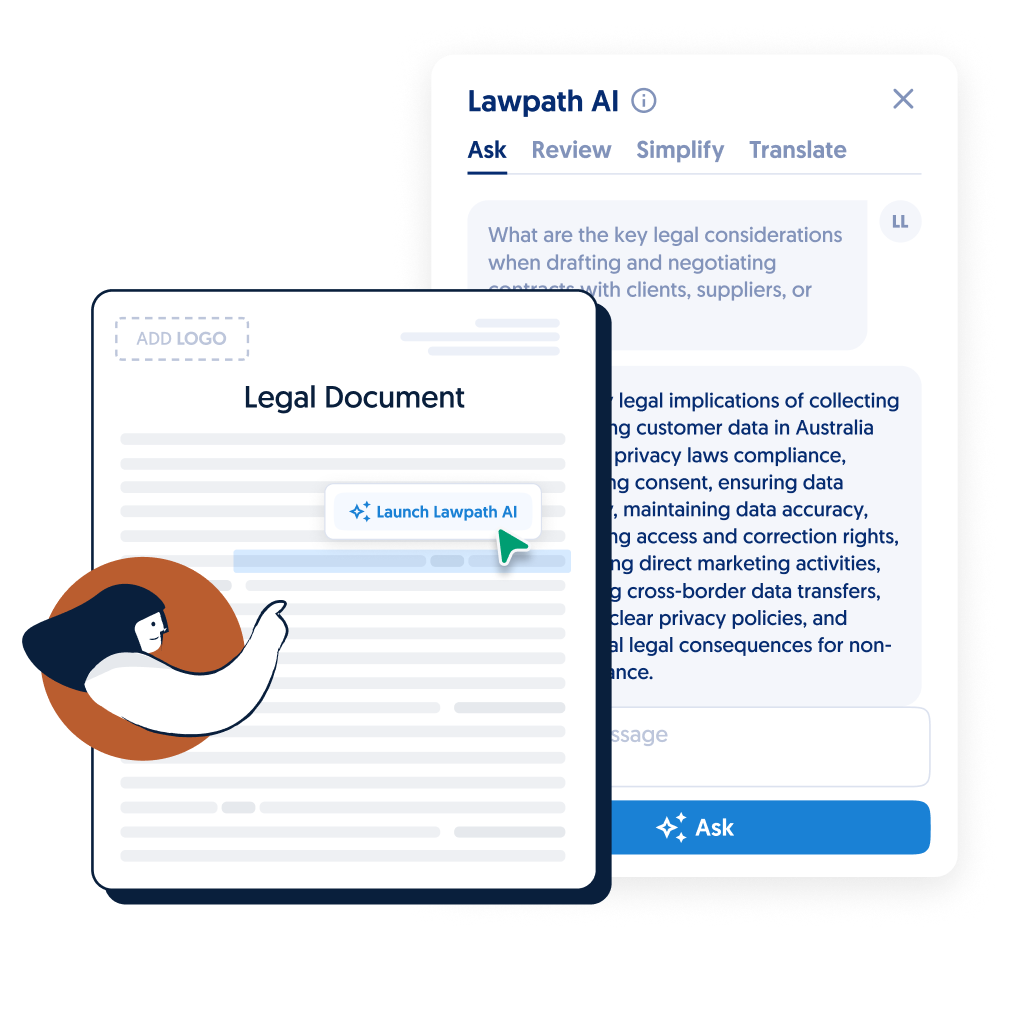
Advanced Al for Personalised Discretionary Trust Deed
Leveraging advanced Al technology and guided questionnaires, we ensure the Discretionary Trust Deed is customised to meet the unique needs and specific requirements of your business.

Efficiency and Convenience
With a few clicks and by answering a guided questionnaire, we incorporate your responses into a professionally drafted Discretionary Trust Deed in under 5 minutes.
How it works
Follow the steps below and you'll have your ready-to-use document in no time

STEP 01
Set up a free account

STEP 02
Search and find the document you need from our list

STEP 03
Follow the prompts and fill in all the relevant details

STEP 04
View and share your ready to use legal document
It's never been so easy
Sign-up to a free Lawpath account
Get started and we'll take care of you. It's that easy.
Browse our 500+ legal documents
Browse our 500+ legal documents to find the perfect match to cover your business needs. We've got Compliance, Employment, Service agreements and more.
Collaborate with e-Sign and Sharing
Having access to your legal documents has never been easier. You can request e-signature, share the document and download for an efficient collaboration.

Here's what people say about Lawpath’s Discretionary Trust Deed
Reviews are managed by BazaarVoice and comply with the BazaarVoice Authenticity Policy. Reviews are independently verified by BazaarVoice and detail our customers' real experiences.
0 reviews
Most Recent
Highest to Lowest Rating
Lowest to Highest Rating
Document Overview
Given the highly specific nature of each user's needs in relation to setting up a trust, it is possible that this template may not meet your needs. You MUST seek advice from a qualified professional before using this deed to check that it meets your specific circumstances.
A discretionary trust is a trust where the distribution of capital and/or income of the trust to the beneficiaries of the trust is at the discretion of you, the trustee. Hence, each beneficiary is not entitled to a fixed entitlement to the trust funds. As the trustee, you will not have complete discretion in distributing the trust and you are limited to the obligations under the trust deed. A discretionary trust has various benefits; most notably, it provides significant asset protection for the beneficiaries.
It is important to understand the state and territory laws regarding stamping and lodging your deed to ensure that it is effective in establishing a trust. A stamp duty may be payable to the relevant revenue authority in your state or territory.
A discretionary trust in the nature of this document allows for control of the trust property without beneficial ownership of it. It provides a unique degree of flexibility in deciding who should benefit from income earned and from capital gains. Persons who might benefit from time to time during the term of the trust (beneficiaries) should be determined when the trust is created. While they may be added or deleted during the life of the trust, stamp duty and income tax considerations should be taken into account before using the power.
Note that a trustee should not also be a beneficiary. This trust deed does not permit it. Ask your legal advisor if you wish to change this arrangement.
The trustee may be one or more of a company or a natural person or a combination of them.A private company, having no activity other than to act as a trustee, is often preferred, as it overcomes problems occurring on the death or illness or absence for prolonged periods of a natural person eg a registered proprietor of land. Care should be taken by persons who are shareholders in specifically disposing of their shares in the trustee company when making a will. Care should also be taken in selection of a trustee to prevent possible conflicts of interest in relation to property or income of the Trust. If a company is to act as trustee of more than one trust or as part of a business, consideration should be given as to whether a financial services licence is required.
A discretionary trust is most suited to a family situation, as a business relationship will require a greater degree of certainty and security in financial dealings affecting trust property.
Additional Foreign Surcharges
Following recent changes to duty and land tax legislation in Australia, a trustee of a discretionary trust fund will be liable to pay additional surcharges on top of other payable duties and land taxes, if any one of the potential beneficiaries of the trust is a foreign person. These additional foreign surcharges vary from each state and territory.
The most effective way to avoid paying these additional foreign surcharges is to include a term in the trust deed that excludes or prevents foreign parties from being beneficiaries of the trust. Another strategy that may be employed to avoid paying these additional foreign surcharges is to ensure that the classification of entities who are beneficiaries to the trust is specific or narrow enough to prevent distributions to foreign parties. You MUST seek advice from a qualified professional before using this deed to check that it meets your specific circumstances.
Tax aspects of discretionary trust
A discretionary trust can result in taxation benefits and if properly implemented should not come within the general anti-avoidance provisions of the Income Tax Assessment Act 1936 (Cth) (ITAA 1936). Distributions of income can be made to corporate beneficiaries or individuals on lower marginal tax rates although special provisions apply to distributions of income to companies and minors.
Discretionary trusts may have capital gains tax advantages over companies especially in regard to individual beneficiaries being able to claim the general discount capital gain (subdivision 115C of the Income Tax Assessment Act 1997(Cth) (ITAA 1997)). This document contains provision to separate various kinds of income or capital to which special taxation treatment is attached.
Foreign persons
Changes have been made to some state legislation which impose surcharge purchase duty and land tax on “foreign” persons. Each jurisdiction has its own definition of “foreign”. Trustees of discretionary trusts may be taken to be “foreign” if the trust has a single “foreign” beneficiary. As part of establishing the trust, instructions should be sought as to whether the trust will purchase or own interests in land in jurisdictions that have these surcharges. If the trust will purchase or own land, consider whether the optional clauses in the deed with respect to “foreign” persons should be used to reduce the risk of the trustee being taken to be a “foreign” person and subject to the surcharges. Note that some clients may not want to use the optional “foreign” beneficiaries clauses as they may want to make distributions from the trust to “foreign” persons. Note also that other states and the Commonwealth have flagged introducing additional taxes or restrictions on foreign persons, and the various legislative definitions of “foreign” persons may change, consequently the deed may need to be updated accordingly – see also comment notes on Definitions and Beneficiaries.
A discretionary trust which includes even one foreign person as a beneficiary and does not place a limit on the amount of corpus or income distributable to the foreign person could be taken to have a “substantial foreign interest” under the Foreign Acquisition and Takeovers Act 1975 (Cth) (see definition of “foreign person” and “substantial interest” in section 4). The FIRB gives the following example in “Who is a ‘foreign person’? [GN31]”:
“Example 4
The Property discretionary trust deed defines the potential beneficiaries of the trust by reference to particular relatives of the grandfather (for example, children, grandchildren and their spouses). The trustee has full discretion over who to distribute the income and property of the trust to. One of the children moves to the United States and as part of taking US citizenship, renounces their Australian citizenship. As this child is a potential beneficiary of 100 per cent of the income or property of the trust, the trustee in their capacity as trustee of the trust becomes a foreign person. Actions of the trustee, such as acquiring interests in residential land in their capacity as trustee, may be both notifiable and significant actions.”
Asset protection strategy
A discretionary trust may also play a significant part in an asset protection strategy, subject to the limitations arising under the Family Law Act 1975 (Cth).
It would generally be unwise to have a person at risk of bankruptcy being the trustee. As to whether the person at risk being able to control the corporate trustee or its identity (via shareholding or directorship or as sole or surviving appointer), this important issue should be addressed as part of taking instructions for establishment of a discretionary trust.
How does a trust assist with asset protection?
A trust can protect you from being sued and potentially losing all of your assets. As the trustee does not legally own the assets, as they are owned by the trust, the assets are not theirs to lose in the event that they get sued. With a discretionary trust, the beneficiary does not own any of the assets in the trust. The beneficiary does not have a contingent interest in any of the discretionary trusts assets and therefore if a beneficiary is attacked by creditors, becomes bankrupt or is divorced, the trust assets will most likely remain secure. With this in mind, this is a great reason to use discretionary trusts when seeking to protect assets through a trust.
Is it possible to remove trustees after setting up a trust?
There are a number of ways that a trustee can be removed, many of which depend on the the terms of the trust agreement and any exclusion clause, termination clause or breach implications it may have. When looking to remove a trustee, the trust instrument would be the place to start. The trust instrument is a document that creates and sets out the terms of the trust. This document outlines the duties of the trustee, but may also provide the process to remove a trustee from a trust. Trustees can also be removed through a court process as well as through a legislation approach within the parameters of the trust. There are also other methods of removing a trustee from a trust and to ensure that this process is done correctly, make sure to seek legal advice in order to find the appropriate way to achieve this process.
Can I transfer control of my trust?
Yes, you are able to transfer control of your trust. Generally there is an appointer who will allocate the transfer of trustee’s in the event of the death of the originating trustee or other circumstances where the trustee is no longer able to carry out their fiduciary duties.
Other documents you may need:
Your first document is on us!
Sign up to a free Lawpath account.
Need additional assistance?
Our experienced lawyers are here to help.